

Corporate partnerships in a changing world
Benefact Group, Corporate Partnerships Report 2022
Earlier this year we brought together larger grant winners from Benefact Group’s Movement for Good awards to talk about the state of the charity sector.
It seemed an opportune moment for our discussions. We are out of lockdown, but not out of the pandemic. The spiralling cost of living and war in Ukraine have added to our anxieties.
So charities hoping for a vaccine-fuelled return to normal have been disappointed. Money is still in short supply, while pressure on services remains high. As a number of our participants testified, there is a burgeoning staffing crisis in the sector, thanks to Covid-related caution and the ‘Great Resignation’.
Benefact Group exists to give its profits to good causes. Being charity-owned means we understand the challenges facing the sector. It gives us the motivation to build a movement for good in society.
One of the ways we do this is encouraging partnerships between businesses and charities, and it was heartening to hear first-hand how flexible and generous some corporate partners have been during the pandemic.
It hardly needs saying that their creativity and commitment is needed now as much as ever. Emergency Covid-related grants have dried up. A new world of remote or hybrid work is changing the nature of corporate fundraising and volunteering.
Our participants talked of the need for easier application and reporting procedures for corporate donations and funding – a common theme at any time. This year, many are looking for the “gold dust” of unrestricted funding, so they can prioritise staff wellbeing and retention. At the same time, there is an acceptance that sometimes corporate partners need to demonstrate return on investment in a concrete way.
Our roundtables produced a lot of food for thought, and we used the insight as a starting point for a quantitative study, with some telling results.
Perhaps the essence of the discussion was this: Covid restrictions may be over, but we are still sailing uncharted waters. This report discusses what that means for charities on the ground and suggests ways that charities and corporate partners can help each other navigate the post-lockdown landscape.
We’d like to thank all of our participants for their time and contribution. We are continually amazed by the sector’s resilience and commitment to making a difference, in good times and bad. You can learn more about Benefact Group’s Movement for Good, including how to apply for this year’s awards, on our website.
Chris Pitt
Group Impact Director, Benefact Group
The post-lockdown landscape
Post Lockdown Doubts
For many charities the post-pandemic world might be summed up like this: there’s more to do, and less to do it with.
Often, there’s less money. The emergency grants that carried many charities through lockdowns have dried up. Organisations lost at least a year of on-the-ground fundraising.
Some corporate partners were incredibly generous during Covid, but remote working put paid to their traditional fundraising and volunteering efforts.
We’ve probably seen the end of lockdowns, but Covid has not gone away. At time of writing, cases are surging. More staff and volunteer days are being lost to illness. Bottlenecks are building.
And then you remember that Covid is not the only crisis in town. In fact, it’s no longer even the most newsworthy. Poverty is rising in line with prices. A European war is exacerbating economic woes and adding new worries to an age of anxiety.
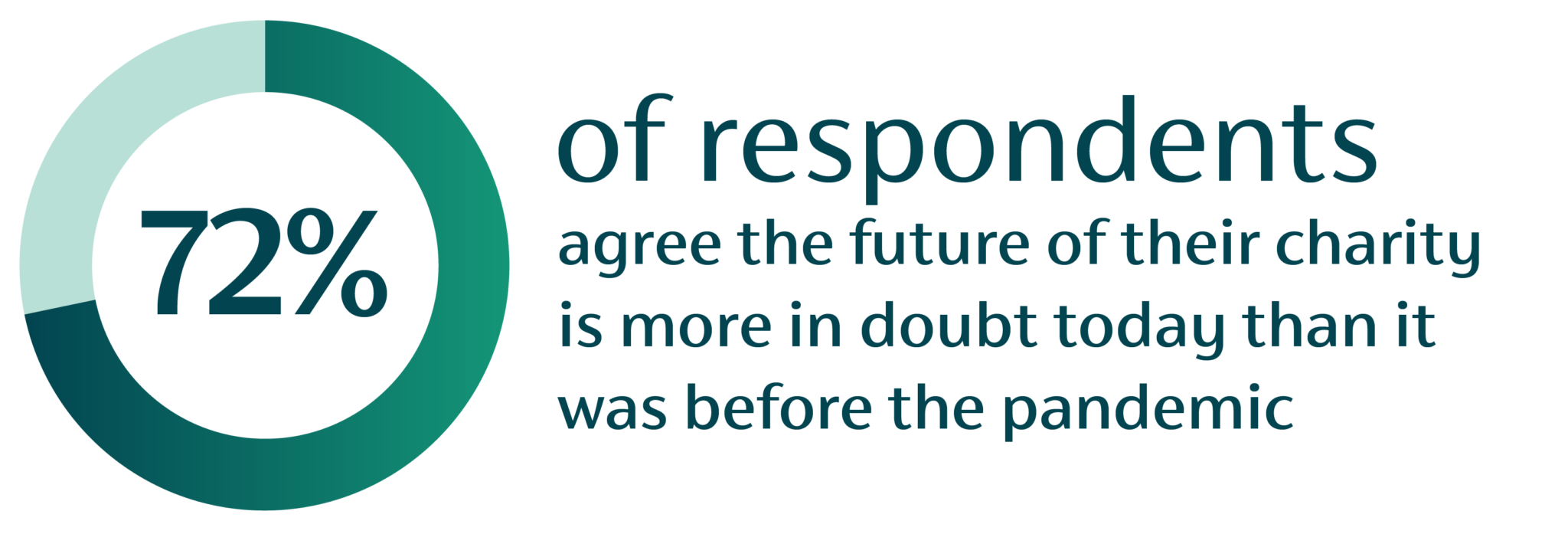
That means more pressure on the kinds of services the third sector so diligently provides. It’s no surprise that 72% of our survey respondents agree with the statement that the future of their charity is more in doubt today than it was before the pandemic.
“I think for us, the main challenge we face is that there’s just such an increased demand for services for the young people that we work with. Many of them hit that first lockdown, and have never been back to school.”
“We’ve seen huge demand for services since Covid, with children and families trapped in abusive households. There has also been a significant increase in sexual violence or certainly sexual violence reporting. As a result, our workers are having to hold larger and larger caseloads of increasingly complex cases.”
A people problem
So there’s more to do, and in many cases less money to do it with. But perhaps the main challenge for charities in the immediate post-pandemic era is around people.
There’s a temporary issue with staff and volunteers that get ill, or are vulnerable and shielding. There is a longer and deeper one around people re-evaluating their priorities, or finding that charity work no longer pays the bills.
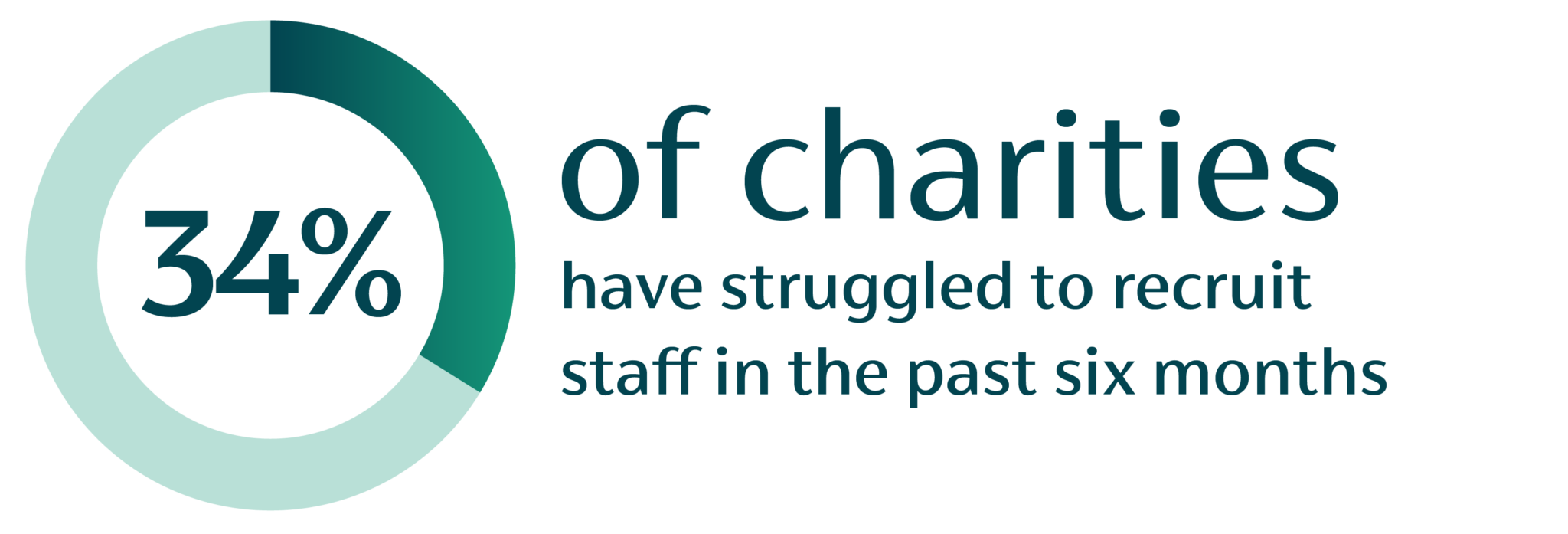
Our quantitative results confirmed what our roundtable participants have found on the ground. According to our study, over a third of charities (34%) have struggled to recruit staff in the past six months and a further 55% say they are recruiting but not as much as they would like.
“We’re a team of 13 – all part time – but four members of staff are leaving or have left. The pandemic was a factor to a greater or lesser extent in all of those. So we’re in a recruitment challenge.”
Nicola Hillary, Transition Network

Are there positives in any of this? Certainly. Charities have adapted, discovered better ways to deliver services and created kinder workplaces. They may also have become more realistic and pragmatic in their search for corporate donations.
“The pandemic forced us to do lots of creative thinking about continuing our service in a different way, and some of that will continue. We trained 650 school workers to be bereavement champions, and we developed grief post packs to send to children.”
Julie Parker, Penhaligon’s friends
The need for corporate partnerships
In this climate, good corporate partnerships are more valuable than ever. But what is a corporate partnership?
For the charities that took part in our roundtables, corporate partnerships are a spectrum. At one end, there are one-off donations. At the other, long-term partnerships that might contribute money, volunteers, equipment and even premises.
In-between are larger awards and grants that charities apply for and may or may not be tied to specific projects, and corporates that support a different charity every year.
Whatever the nature of the contribution, charities and potential partners always need to ensure their ambitions and outlooks align. Companies need to be realistic about what they can expect in return for their largesse.
“To find unrestricted funding is gold dust to us, because we can use it flexibly and we can use it on our core endeavours. It means we can more easily adapt to changing circumstances as we go through the year.”
Our roundtable participants highlighted a new issue in the aftermath of Covid lockdowns: the need for more unrestricted funding.
More than ever, charities want to spend corporate money on the kind of things that help them recruit and retain staff, like salaries and welfare benefits.
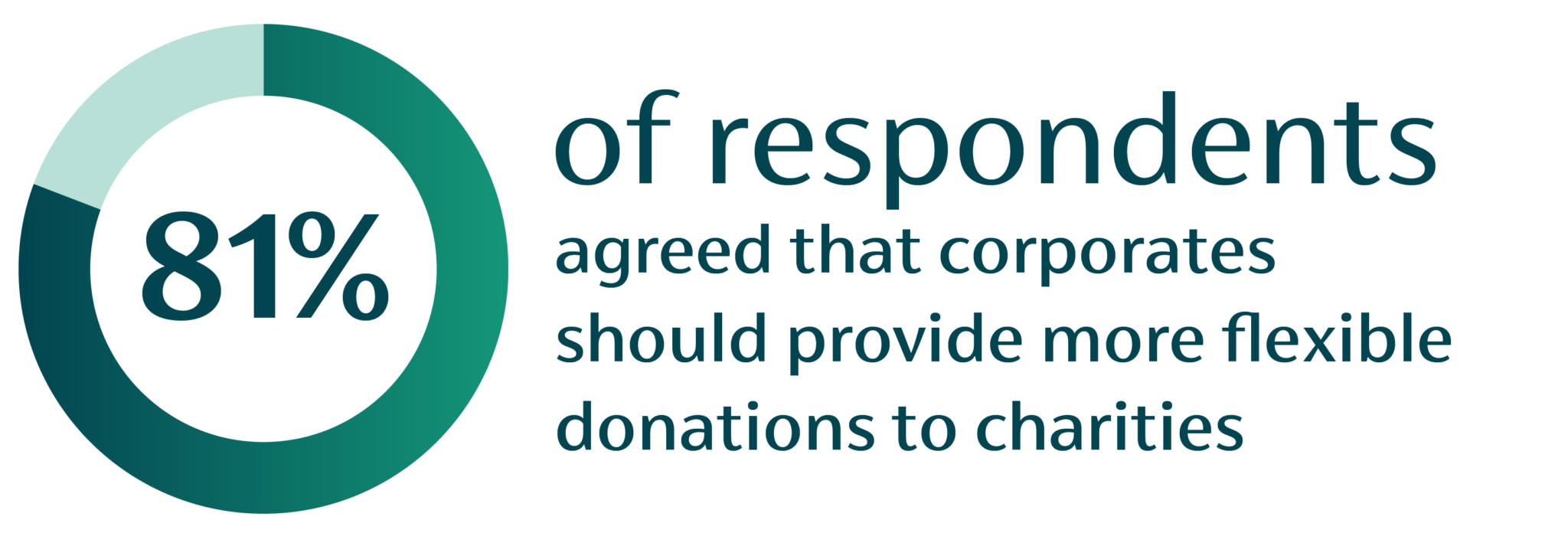
In our study, 81% of respondents agreed that corporates should provide more flexible donations to charities so they can use the money to meet core needs.
By contrast, corporate marketing and HR departments want charity engagements that bring conclusive, shareable results: a completed project, a successful event, a repainted office.
Those contrasting priorities create a dilemma, but also an opportunity for honest, open dialogue around the fundamental purpose of charity/corporate partnerships.

Section 1
A crisis of talent?
In the corporate world they call it the Great Resignation. The pandemic experience persuaded many of us to re-evaluate our lives and focus on the pursuit of personal fulfilment.
To some, that means reducing time spent at work or retiring early; for others, going freelance or changing careers altogether.
Charity workers are not immune to these temptations. According to the CharityJob website, charity sector applications fell by three-quarters during 2021.
And charities are facing a talent squeeze on three fronts. The Great Resignation is one. Another is the cost of living crisis, which is pushing employees towards higher paid roles in the private or public sectors.
The third is an ongoing pandemic that continues to take staff and volunteers off the front line, either through illness or the fear of it.
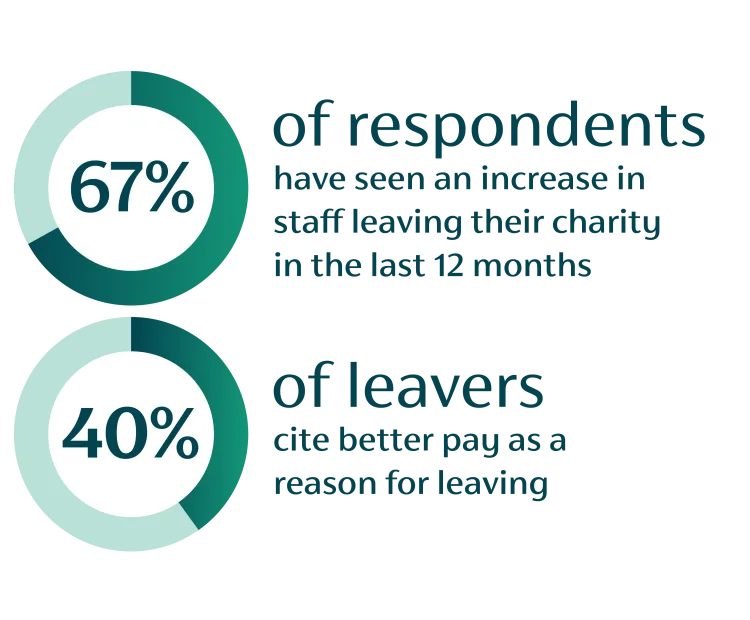
The result is a staffing crisis. In our study, two thirds of respondents (67%) say they have seen an increase in staff leaving their charity in the last 12 months, and nearly 40% of leavers cite better pay as a reason for leaving.
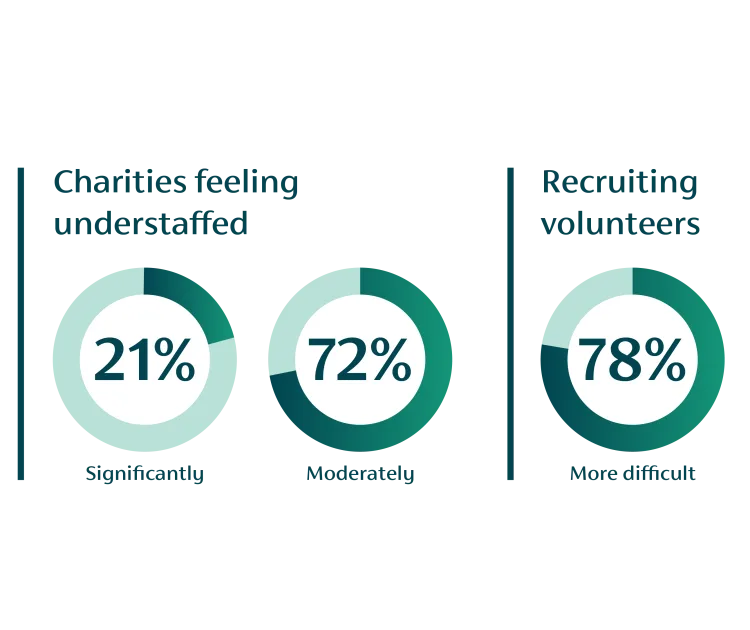
Nearly every charity in our survey feels understaffed to some extent: 21% significantly and 72% moderately. Over three quarters (78%) of charities also say they are finding it more difficult to recruit volunteers.
“We had 80 active volunteers before the pandemic. We have 40 now. That’s left our small staff team having to do much more.”
Julie Parker, Penhaligon’s Friends
“We recruited recently and given that we were advertising an attractive looking job, it was surprising just how difficult it was.”
Coralie Hopwood, FarmAbility
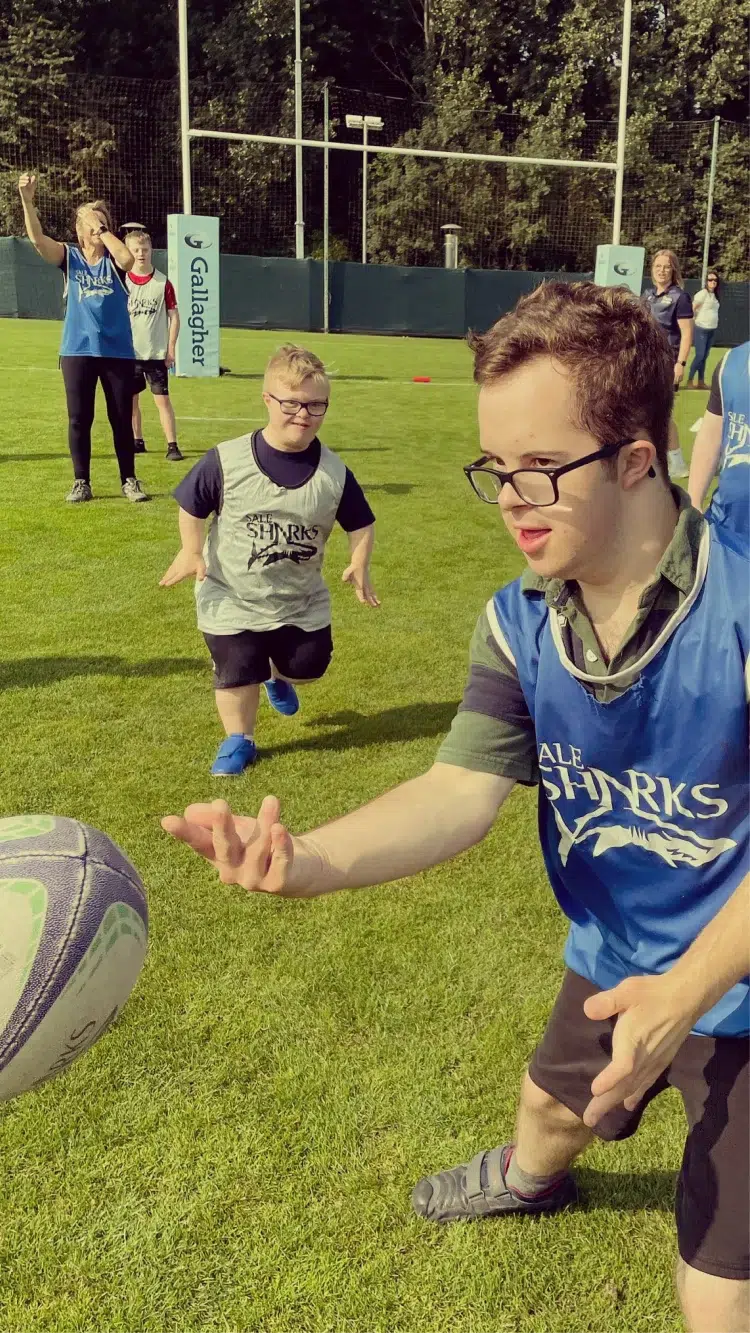
“There’s a huge challenge over recruitment of staff. Lots of people who might previously have wanted to work for an organisation like Sale Sharks are instead looking for what they see as more stable positions.”
Alison Warwood, Sharks Community

Wellbeing: is Covid a tipping point?
In all of this, one beacon of progress shines out. The pandemic may prove a turning point in charities’ attitude to wellbeing at work.
Prior to Covid, wellbeing initiatives were often seen as an indulgence, especially in smaller organisations.
To some extent, they still are. But the disruption of lockdown has forced charities to take the mental and physical health of their staff and volunteers much more seriously.
“There’s still that sense that the money we’ve received should be for the children – we shouldn’t be spending it on the staff. There’s still that fear factor.”
Chris Downton, Children with Cancer Fund
That shift was perhaps inevitable. Charity workers went from bustling offices to lonely back bedrooms almost overnight.
They grappled with Teams and Zoom, switching to virtual support and, in many cases, virtual service delivery. Pressure grew and mental health suffered.
The end of lockdown has not flicked a switch to how things were before. Charity workers’ deep commitment to their cause helped them keep going through the darkest days of the pandemic. They may be paying for it now.
“There was a real resilience through lockdowns, fighting fires every day. But 18 months down the line it catches up with people. And I think the phase we’re in now has brought a new issue over how sustainable this pressure is on our staff, and presents us with the challenge of making sure our staff have room to breathe.”
Cath Collier, First Light
A new focus on welfare
The focus on welfare that started during the pandemic has continued into the post-lockdown period. That may prove to be the most positive outcome of the last two years.
The regular check-ins, virtual socials and small acts of kindness that proliferated during lockdown are morphing into more formal wellbeing strategies.
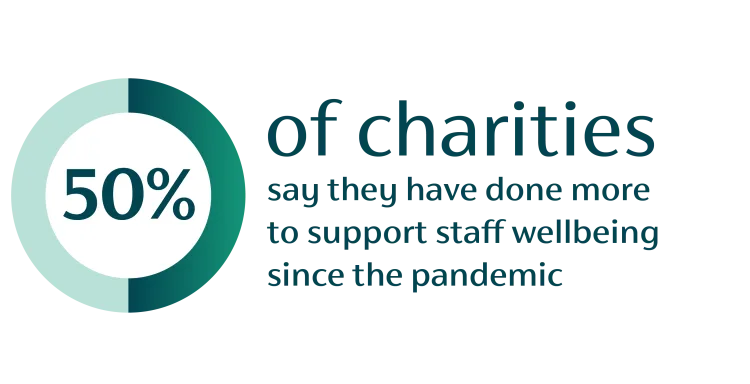
In our survey, half of charities (50%) say they have done more to support staff wellbeing since the pandemic.
This is out of both a genuine concern for staff wellbeing, and the need to react to the talent crisis. Organisations are spending now to save on recruitment and training costs later.
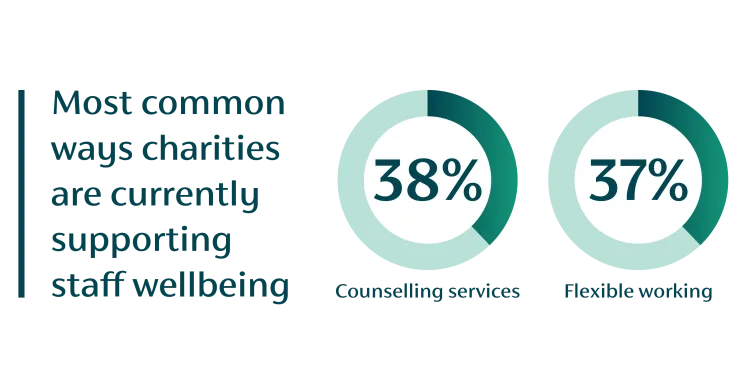
What welfare means on the ground depends mostly on the size of the charity. Buddy systems and welfare packs are common in the smallest organisations. Larger ones are dusting off long-forgotten wellbeing strategies and considering private health insurance. Our survey found that counselling services (38%) and flexible working (37%) are the most common ways charities are currently supporting staff wellbeing.
Everybody is doing something, and in many cases charities are being upfront about the need to fund these initiatives. They are less coy about spending on staff.
“With funding applications, we’ve started including a line on our budget for welfare costs. It’s become really important for us to be able to provide these things for our team.”Coralie Hopwood, FarmAbility
Section 2
A trend towards localism
In lockdown, we worked at home and exercised nearby. City centres fell silent while suburban parks filled with socially distanced walkers and joggers.
In other words, our horizons narrowed, and we became focused on what was local, available and convenient. Neighbours formed support groups. The global internet became a conduit for news about pasta supplies in the shop down the road. We all became localists, at least temporarily.
But how temporarily? Some businesses and charities have adopted the home working model permanently. Many more have switched to semi-remote hybrid work.
The upshot is that many of us are spending more time in our local communities than we ever did before the pandemic.
How might this affect the sector? Some of our charities noticed an increase in donations from local businesses, and of corporate partners wanting to be involved in local initiatives.
They saw a rise in individuals and organisations wanting to do something for the community, as local support networks took on greater significance during the pandemic.
The instinct to prioritise local causes is not new, but it has grown with the pandemic. Promoting local micro-relationships might be an avenue for charities to explore as more of our lives conform to “15-minute city” models.
That’s the idea that all our everyday needs should be met within a 15-minute walking radius of where we live. It’s touted as a climate change measure, but the pandemic may have accelerated the informal adoption of many of the concept’s core principles.
We’ll have to wait and see how that pans out, but the consequences of this new localism are something charities certainly need to start thinking about.
How do corporate relationships work in a world where private and public sector employees are only together in a central location occasionally? How can charity initiatives engage a dispersed workforce?
If the world of work is fundamentally changed, partnerships between charities and businesses will have to change with it.
“People suddenly discovered parks they hadn’t known about. They discovered local spaces, and made local connections.”
“Our main sponsor is actually wanting to do more, and to give back locally. So with their help we’re running a mental health programme with 30 local schools, looking at how young people are coping in the aftermath of Covid disruption.”
Section 3
Understanding charity needs – how corporates can help
Businesses will help charities in any number of ways, just as they always have. But Covid may have shifted the emphasis in some areas.
Money is always useful – but not at any price
The pandemic cut resources to the bone. Charities are struggling to recruit employees and volunteers. Corporate donations aren’t worth it if there are too many strings attached.
Demands tend to be most unbalanced around application and reporting processes. Over a quarter (27%) of charities in our survey favoured easier funding application procedures.
Streamlining them would save charities a lot of time. One of the main reasons our respondents gave for not approaching potential corporate partners was the fear that it would cost too much to administrate.
If you’re asking a small charity for detailed line by line reporting on the results of your largesse, you might not be benefiting their cause in the way you hope.
In the current climate, don’t make charities jump through hoops for small pots of money.
“We have to report on a lot of the same things that larger organisations have to report on, but that’s a huge burden for us. We have to spend a lot of administrative time simply showing that we’ve met the criteria.”
“If corporate engagement is something you really have to go out and chase, it might not be worth your while, because it’s going to cost you a lot of time administering that relationship.”
Can donations be unrestricted?
As we’ve already seen, in the current crisis charities need to use funds for more effective recruitment and retention, among other things. If your donation is tied to a particular project or a particular result, they can’t do that.
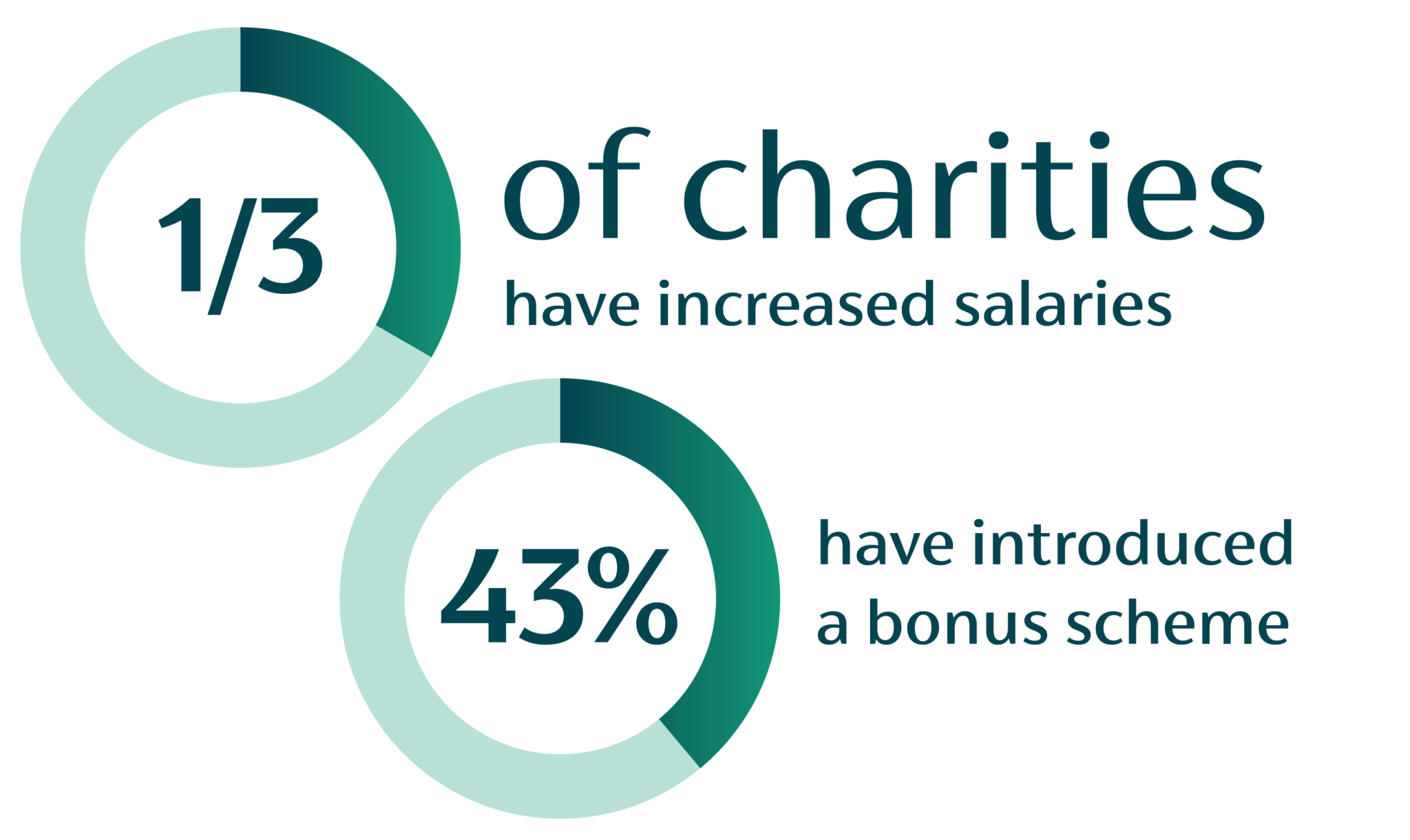
Our survey highlights the way many charities are having to spend more to find and keep good staff. A third of them have increased salaries, and 43% have introduced a bonus scheme. Recruitment and retention is costing charities more, and they need corporate help.
If you can trust the charity to spend your money in the best way for them, please do. If you need to see results, at least allow the beneficiary to earmark a percentage of your donation for everyday operations.
Think beyond the photo opportunity
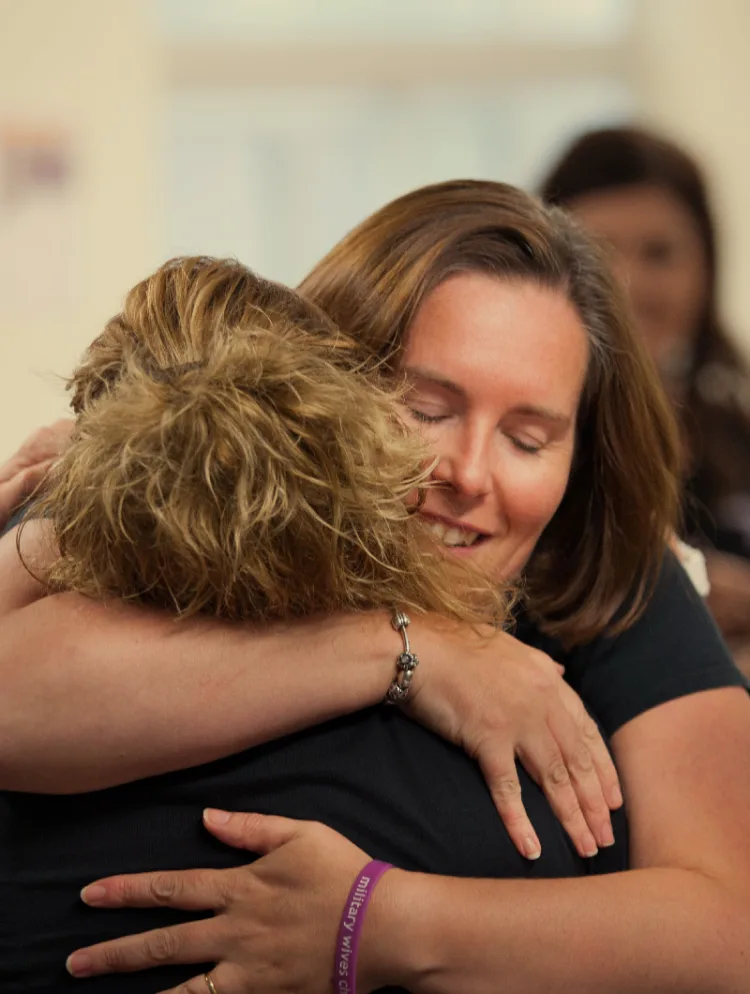
As one of our roundtable participants commented, corporate volunteers often like to build things, even if their charity partner doesn’t really need a new outhouse or gazebo.
Corporates offering volunteer days should think beyond the photo opportunity. Professional services volunteering – marketing, bookkeeping, HR – can be much more useful than a day of digging, hammering or painting. Having said that, sometimes charities do just need to fill a skip.
It’s crucial to communicate and compromise. Corporates shouldn’t go in with preconceived ideas of what they will do, and charities should have a clear idea of what they need.
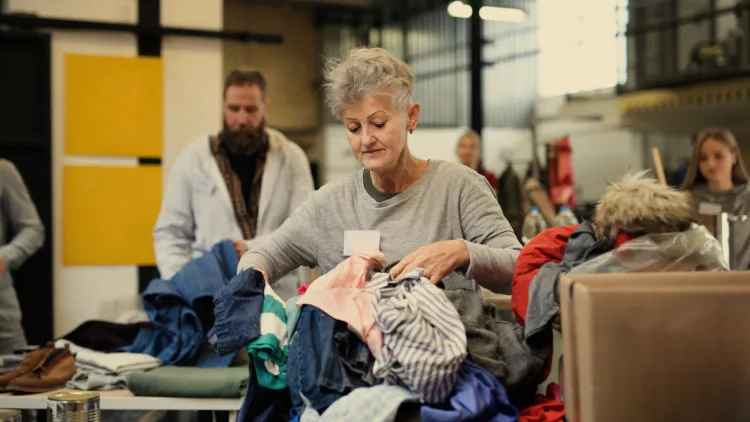
In the aftermath of Covid lockdowns, many charities have moved to smaller offices or given them up altogether. The temporary loan of unused premises or even just a room (for meetings or recruitment interviews, for example) can be a huge benefit.
In our survey, over a fifth of charities (21%) said providing office space would be a way for corporates to better support the sector. Fully a third (33%) wanted companies to donate their old equipment, from computers to office furniture.
Section 4
Understanding corporate needs – how charities can help
A corporate partnership should be just that – a partnership. Charities can help businesses in a number of ways.
“Funding from one local organisation came about because we developed a relationship with the CEO, who wanted to ask our advice on various things. After that, we felt far more able to ask them for money!”Siobhan Geoghegan, Common Ground CLG
“By supporting a charity such as ours it reveals a gentler, kinder, more socially conscious business. It also shows local communities that the business isn’t only in it for the profit margins and that it does want to play an active role in society, to make a positive difference.” Survey respondent
Understand corporate priorities
While corporates shouldn’t expect too much in the way of administration from hard-pressed charities, it’s also true that charities need to understand corporate priorities.
Companies are usually genuine in their desire to contribute to the cause, but they also want results that are meaningful to them. That could mean photos for the marketing department. It could mean useful data for recruitment drives, staff newsletters and ESG reporting.
It’s a compromise. The relationship needs to work for both parties. Charities might be advised to welcome the occasional resource-intensive volunteer day if it helps nurture a lucrative long-term partnership.
Offer your expertise
Charities are brilliant at forging links to local communities, and can help corporate partners do the same. Maybe you can offer businesses space in your newsletter, or a presence at your next event? Charities should mention partners in their PR efforts.
In addition, charities often have expertise that corporates can benefit from. For example, one small charity delivers workshops on mental health for employees as part of its partner’s wellbeing at work programme.
Many charities can also offer experience of navigating regulatory reporting requirements, perhaps around ESG.
Section 5
Conclusion
Charities were locked into emergency mode for much of the pandemic. The lifting of all restrictions earlier this year has given them time to assess the damage and plot new paths forward.
Predictably, they have lost money. Less predictably, they’re also losing talent. Recruiting and retaining the employees they need may be the biggest challenge for charities in the immediate post-restriction period.
Many are trying to meet that challenge, with better pay (if possible) and a greater focus on wellbeing at work. But these things cost, and charities need help from corporate partners to pay for them.
Charities want funding that is easy to get and easy to manage, so more of the money can go towards making a difference. That means being able to spend at least some of it in a way that persuades talented staff to join or stay.
These were clear themes in our 2022 Movement for Good roundtable discussions and our accompanying charity survey. It’s hugely positive that the wellbeing of the third sector workforce (paid and unpaid) is taking centre stage. It’s vital now that donors get on board.
Our participants saw other positives in a world turned upside down. New ways of working and delivering services have survived the pandemic and will make charities more efficient for the future.
There was also plenty of appreciation for corporate partners and funders. Many have been flexible and creative in the ways they have helped charities survive over the last two years.
Charities need that to continue. Cash-strapped businesses might offer equipment or office space instead of money. Volunteers are always appreciated, if their activities are well planned and appropriate. When it comes without strings, cash from a company’s Christmas charity appeal or summer bake sale could make all the difference to a small local organisation.
The usual caveats apply. Values need to align. Both parties need to be on the same page in terms of obligations and expectations.
But corporate support will be vital for charities in an era of overlapping crises. The more streamlined, relevant and unrestricted it is, the more good it will be able to do.
Contributors
Chris Pitt, Group Impact Director, Benefact Group
Siobhan Geoghegan, Director, Common Ground CLG
Coralie Hopwood, CEO, FarmAbility
Alison Warwood, CEO, Sharks Community Trust
Cath Collier, Trust and Grants Fundraiser, First Light
Chris Downton, Co-Founder, Children with Cancer Fund
Julie Parker, CEO, Penhaligon’s Friends
Nicola Hillary, Funding Manager, Transition Network